

Equipment finance has always followed the way businesses use productive assets. When ownership made sense, the market built around ownership. When customers needed balance-sheet flexibility, leasing expanded. When speed, tax treatment, cash flow, and residual value became more important, lenders and lessors created structures to match.
The next adjustment is already underway. Customers are asking for finance terms that reflect how equipment is actually used.
A recent Monitor Suite (subscription required) article, “The Shift to Usage-Based Equipment Finance and the Structures That Work,” put real numbers behind that shift. Monitor reported that 48% of equipment dealers lost at least one sale in the prior 12 months because their finance partner could not structure a usage-based or metered option. The article also cited Secured Research data showing that 61% of dealers reported increased customer requests for consumption-based or rental-to-own terms over the prior 24 months.
A second MonitorDaily article, “Is Pay-Per-Use Failing? Exploring Value Proposition & Overcoming Implementation Challenges,” adds an important caution. Pay-per-use has been discussed for years, but it remains the exception rather than the norm in traditional equipment finance. The reason is not lack of customer interest. It is that pure pay-per-use changes the risk-reward profile of the transaction. The lessor is no longer simply underwriting a borrower and an asset against a fixed repayment schedule. The lessor is underwriting usage, customer behavior, asset productivity, data quality, billing variability, and, in some cases, a share of the customer’s operating upside.
That caution makes the platform question even more important. Usage-based finance will not scale because the market likes the idea. It will scale when lenders can align the product structure, risk appetite, data flow, billing logic, and portfolio controls behind it.
Those figures should get the attention of every equipment finance leader. Not because usage-based finance is new. Most lenders have seen some version of it before. The signal is that customers and dealers are beginning to treat flexibility as a requirement, not a favor.
Customers & dealers are treating flexibility as a requirement, not a favor.
The question for lenders is whether their operating model can keep up.
A usage-based structure can look simple in the sales conversation. A customer wants to pay against hours, miles, units, cycles, production volume, or some other measure of output. A dealer wants to preserve the sale and keep the customer inside its service and replacement cycle. A lender wants to support the relationship without creating uncontrolled risk.
The complexity starts after the contract is booked.
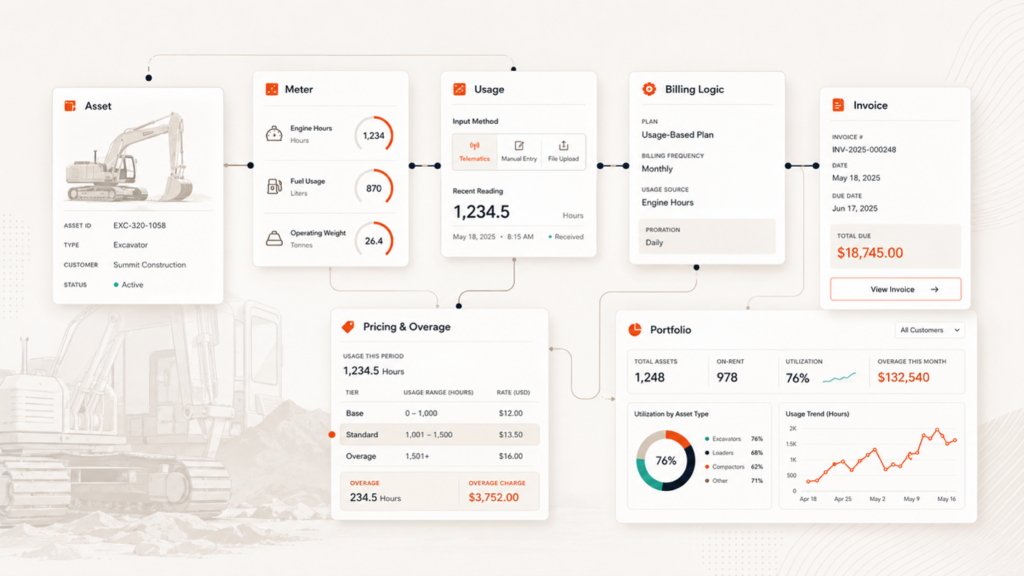
Usage-based finance changes the behavior of the contract. It introduces meter readings, meter types, thresholds, overage logic, billing adjustments, utilization bands, asset status, exception handling, and residual exposure. It changes how servicing teams work, how billing is reconciled, how disputes are handled, and how portfolio managers understand performance over time.
That is why usage-based equipment finance is not simply a product feature or a creative structuring technique. It is a platform test.
The dealer has already moved
The Monitor article is especially useful because it looks at the market from the dealer’s point of view. Dealers do not live on the finance contract alone. They live on the relationship around the asset: the sale, service, parts, attachments, upgrades, replacements, and repeat business that follow.
When a finance partner cannot support a structure the customer is asking for, the dealer’s risk is not limited to a lost transaction. The dealer may lose the service relationship, the upgrade path, the next replacement cycle, and the long-term customer connection.
That changes the role of the funder.
In a fixed-payment world, the finance partner helps close the sale. In a usage-based world, the finance partner helps the dealer keep the customer. That is a more valuable position, but it also requires more operational discipline. The funder has to understand the asset, the contract, and the usage pattern well enough to finance flexibility without turning every deal into a special case.
The lenders that solve this will become easier for dealers to call first. The lenders that cannot will be asked to explain why their systems are the constraint.
The hard part is not the term sheet
A common mistake is to treat usage-based finance as a front-end problem. Can we structure it? Can we price it? Can we win the dealer’s business?
These questions are important, but they do not decide whether the model scales.
The harder questions come later. Can the system accept the right usage inputs? Can it distinguish between meter types? Can it apply the correct contract logic to the correct billing period? Can servicing teams see what changed and why? Can exceptions be handled without creating operational drag? Can portfolio leaders see whether usage-based structures are performing across assets, customers, programs, and dealer relationships?
There is also a risk question that cannot be ignored. A pure pay-per-use model changes the lender’s economic exposure. The lender is no longer relying only on fixed scheduled payments. It is taking a view on utilization, data integrity, asset productivity, customer behavior, and the reliability of the usage model itself. In some structures, the funder is moving closer to a shared-outcome model than a conventional loan or lease.
If the answer depends on spreadsheets, manual workarounds, or institutional memory, the lender may be able to support a handful of deals. It will struggle to build a repeatable program.
Usage-based finance puts pressure on the full lifecycle. Origination has to capture the structure correctly. Servicing has to bill it accurately. Asset management has to understand utilization. Risk teams need visibility into exposure. Portfolio leaders need to know whether the economics are holding.
A flexible offer without lifecycle control can become expensive very quickly.
Where Solifi fits
Solifi supports usage-based finance across different secured finance operating environments, with capabilities aligned to how different lenders and lessors run their businesses. The details matter because usage-based finance only works when the asset, contract, usage terms, billing process, and portfolio record stay connected.
For enterprise equipment finance, ROS and ILS on Solifi OFP create a full end-to-end path from origination and onboarding through portfolio management, servicing, and invoicing. ROS supports the origination and onboarding of the structures that ILS manages downstream, giving lenders a connected operating model rather than a handoff between disconnected systems.
In ILS on Solifi OFP, metered usage is managed as part of the contract and invoicing lifecycle. A meter reading captures the number of units consumed at a point in time. Solifi uses those readings during invoicing to calculate usage charges against the meter assigned to the asset.
The calculation reflects the real economics of metered usage. The system considers the current meter reading, previous meter reading, allowable units, and meter service or test units before calculating overage units. Those overage units are then multiplied by the applicable rate to generate the charge. Rate types can be configured with tiered pricing, so different usage thresholds can carry different rates. ILS can also create separate usage charges for each rate type on a meter.
FMO on OFP supports excess or under mileage usage for automotive assets through configurable usage types. Lenders can work with mileage, kilometers, hours, copies, or custom units of measurement, each with its own meter code and denomination. Annual usage can be captured by asset line, with usage rate rules used to calculate charges or refunds based on excess or under-usage. Tolerances can be configured as fixed amounts or percentages of contracted usage, and rules can combine fixed and variable calculation methods.
Leasepath supports a different part of the operating model. It can ingest a file with billing information, including metered usage, and bill accordingly. It does not calculate usage and then calculate billing based on that usage. For mid-market lenders, that distinction is important. Leasepath can support billing execution when calculated billing information is provided, while ROS and ILS on OFP, along with FMO on OFP, provide deeper native usage logic for lenders that need the system to originate, onboard, calculate, and manage usage-based structures through the lifecycle.
This is the practical difference between broad market interest and operational readiness.
Usage-based finance breaks down when the logic sits outside the secured finance operating environment. If the usage structure is captured in one place, the meter is tracked in another, the rate structure sits in a spreadsheet, and the invoice is generated somewhere else, the lender has flexibility in name only. The operational risk sits in the gaps.
Solifi’s advantage is that it understands those gaps. Usage-based finance is not just a pricing concept. It is an asset finance operating discipline. The platform has to support the contract terms, usage inputs, billing logic, asset record, servicing workflow, and portfolio controls that make flexible structures reliable after the deal is live.
The next divide in equipment finance
Usage-based finance will not replace every traditional loan or lease. Many customers will still prefer predictable payments. Many assets will still fit conventional structures. Many lenders will take a measured approach, as they should.
But the direction is clear. Customers are becoming more sensitive to utilization, cash flow, and asset productivity. Dealers are looking for finance partners that help keep opportunities moving. Funders are being asked to support more flexible structures without losing control of billing, risk, or residual economics.
This combination creates a new divide in the market.
The customer sees flexibility. The lender has to manage the contract behavior behind it.
Some lenders will treat usage-based finance as an accommodation. They will handle it manually, price it cautiously and limit it to exceptions. Others will build the operating capability to support it as part of a broader asset finance strategy.
The second group will have an advantage with dealers. They will see more of the customer relationship. They will learn faster from utilization data. They will understand which structures perform, which assets behave well, which customers expand, and where residual risk begins to move.
That is the larger opportunity. Usage-based finance is not only about giving customers a more flexible payment. It is about creating a more informed finance model around the way equipment performs in the real world.
For equipment finance leaders, the practical question is no longer whether customers will ask for usage-based structures. Monitor’s reporting suggests they already are. The better question is whether the platform behind the business is ready to run them.